Thursday, November 5, 2009

Mystery Comics Digest #18: "Mars: Dead Or Alive"


Download Mystery Comics Digest #18


Submitted for your approval and disposition: Western Publishing published a Twilight Zone comic book, first under their Dell Comics imprint for 4 issues, one in 1961 and 3 further issues in 1962, with the first two published as part of their long running Four Color anthology series as issue numbers 1173 and 1288, and then two further one shots numbered separately in Dell's unique fashion as 01-860-207 and 12-860-210 (numbered as 01-860-210 on the inside) respectively. Western then restarted the series under their Gold Key imprint with a formal issue #1, which ran 92 issues from 1962 to 1979, with the final issue being published in 1982.

Several of the stories would be reprinted in their Mystery Comics Digest, which mentioned the title on the covers. A wide range of artists worked on the title, including Jack Sparling, Reed Crandall, Lee Elias, George Evans, Russ Jones, Joe Orlando, Jerry Robinson, Mike Sekowsky, Dan Spiegle, Frank Thorne and Alex Toth.

I originally read "Mars: Dead or Alive" in Mystery Comics Digest #18, which I obtained after begging my mother to buy it for me in Rexall's Drug Store. Unfortunately, my scanned copy is incomplete, but don''t worry as this story is included in the download. I don't know who scripted "Mars," but Nevio Zaccara penciled and inked this surprisingly well told science fiction tale. One must overlook the fact that it would probably take years for a manned spacecraft to reach the planet Mars, but at least the story forces one to think. I sincerely hope that you enjoy this as I did when I was ten years old way back in July of 1974, which was the mag's publication date.


Credits

Cover painting: George Wilson
Script: Unknown
Pencils: Nevio Zeccara
Inks: Nevio Zeccara

Reprinted:
  • from Twilight Zone (Gold Key, 1962 series) #17 (September 1966)


Tuesday, November 3, 2009

Comix International #3: Dax the Damned in "Chess"


Download Comix International #3


In a period of time before recorded history, a great hero of that era struggles for survival in a savage world. It's a world filled with hideous monsters, beautiful women, and dark sorcery. Though a great and noble hero, Dax is damned to meet a most unpleasant fate in the end. This fondly remembered and long-running series is the creation of the great Spanish artist Esteban Maroto.

Born in Madrid, Maroto began his career in the 1960s with series like Cinco por infinito, published in English by Continuity Comics as "Zero Patrol, which was heavily retouched by editor Neal Adams.

Maroto joined Warren Publishing in November 1971 when artists from the Spanish agency Selleciones Illustrada started appearing in the their three horror magazines, Creepy, Eerie and Vampirella. Maroto's first story, "Wolfhunt", appeared in Vampirella #14. Maroto quickly became one of the most well known and critically acclaimed Spanish artists at Warren. He would eventually draw 101 stories for them, more than any other artist except Jose Ortiz. Maroto won
the Warren Award for best artist/writer in 1972, and his story "A Scream in the Forest" won the best art in a story award in 1973. Maroto remained with Warren until its folding in 1983.

Two of Maroto's series were reprinted in Eerie and Vampirella. Manly, renamed Dax the Warrior, was reprinted in issues 39-41, 43-50 and 52 of Eerie. All of issue 59 was dedicated to Dax, which reprinted again the majority of these stories. His series Tomb of the Gods was reprinted in Vampirella issues 17 through 22.

He also contributed black-and-white illustrations for the Roger Zelazny book Changeling and Larry Niven's The Magic Goes Away.


Credits

Script: Esteban Maroto
Pencils: Esteban Maroto
Inks: Esteban Maroto


Reprinted:
  • from Eerie (Warren, 1966 series) #41 (August 1972).
  • in Eerie (Warren, 1966 series) #59 (August 1974).


Special surprise bonus download: Xotica, the Art of Esteban Maroto


Download Xotica: The art of Esteban Maroto

Monday, November 2, 2009

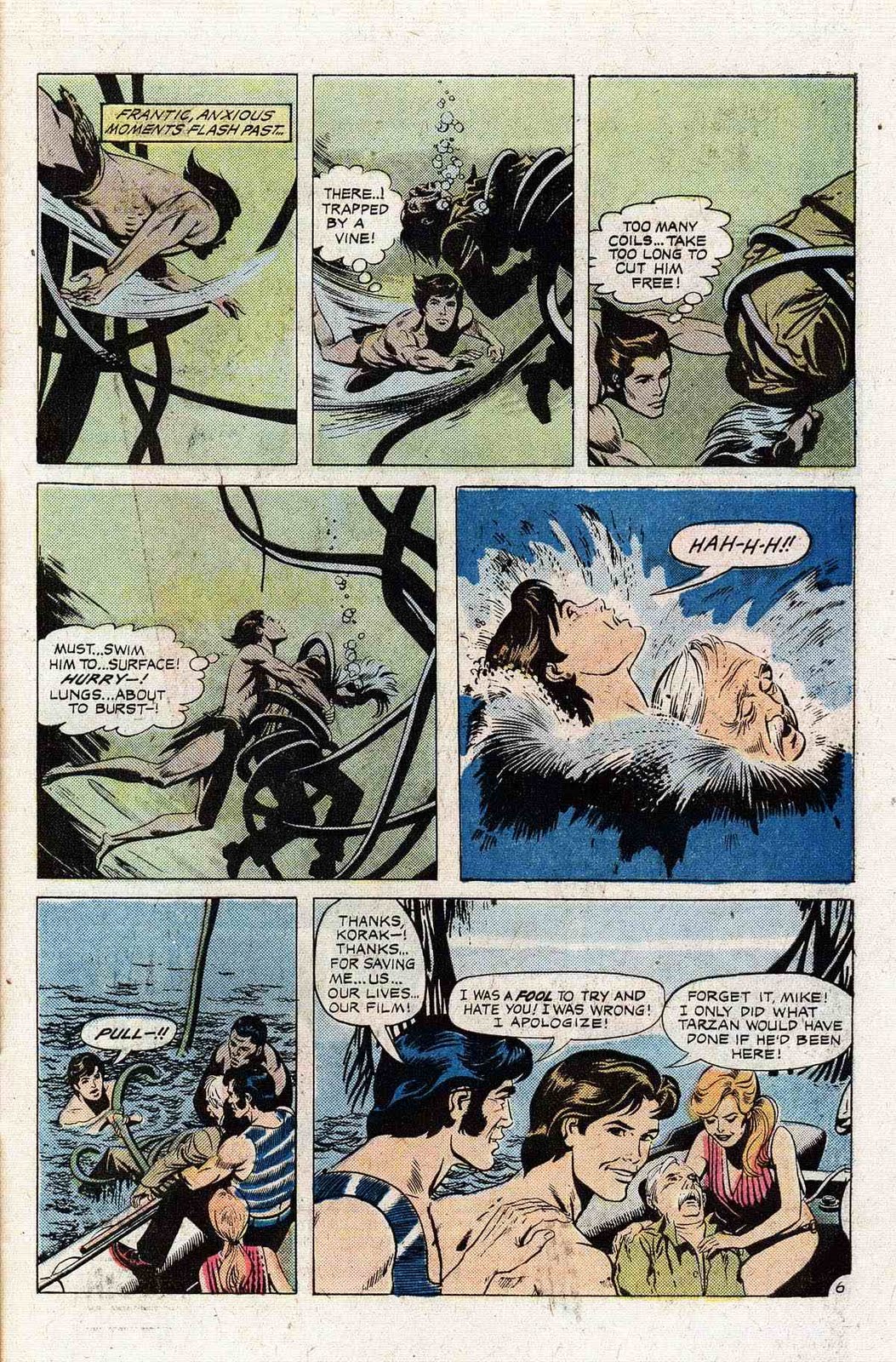
Korak, Son of Tarzan #59: "School for Slaughter"


Download Korak Son of Tarzan #59


Tarzan's son made his earliest appearance in comic books in 1940, when Comics on Parade began serializing the newspaper-strip adaptation of Edgar Rice Burroughs's The Son of Tarzan. Nearly two and a half decades later, Dell Comics got around to publishing a Korak, Son of Tarzan comic book. Art was by Russ Manning and Warren Tufts. That was published between 1964 and 1972. DC Comics took over the title but stuck with it for only fourteen issues. Joe Kubert provided all the covers, and Frank Throne was the first artist.

On a personal note, this particular issue is the best Korak story that I have ever read, which is only underscored by the fact that Joe Kubert scripted it. While this story was nicely illustrated by Rudy Florese, the back up story contains stunning art by Russ Manning.


Credits

Cover: Joe Kubert
Script: Joe Kubert
Pencils: Rudy Florese
Inks: Rudy Florese


Saturday, October 31, 2009

Ghost Manor #29: "An Old Man"


Download Ghost Manor #29


Former actor, TV anchorman, and low-budget movie director, Pat Boyette switched careers again in the middle 1960s. Also an artist, he went to work for Charlton Comics. An avowed Texan, he stayed home in San Antonio and worked through the mail for the Connecticut-based publisher. "Although Charlton was not known for paying big fees," he once admitted, "it gave me an opportunity that the other companies didn't offer and that was the freedom to experiment, to do as I wanted, to make changes, to be happy."

During his nearly two decades with the company, Boyette produced an impressive amount of work for such titles as Ghostly Tales, Billy the Kid, Flash Gordon, Fightin' Marines, The Phantom, and Peacemaker, whose description was "A Man Who Loves Peace So Much That He Is Willing TO FIGHT FOR IT!"

When Charlton editor Dick Giordano moved to DC, he invited Boyette to work for them. He drew two issues of Blackhawk before returning to Charlton—"DC at the time demanded a regimentation that I wasn't readily eager to adhere to."

Boyette, while he did now and then work in a cartoony style, usually drew in an attractive illustrative style. His favorites were Roy Crane, Milton Caniff, and his friend Alex Toth, whose work he felt was "a perfect marriage of the attitudes of Caniff and the attitudes of Roy Crane." Boyette, who drew also for the Warren black-and-white titles, even published a few comic books of his own. At one point he went so far as to draw a revived Spencer Spook.


Related Posts Plugin for WordPress, Blogger...